


As people around the world celebrated the Lunar New Year last week, one of our education ambassadors said goodbye to the Year of the Snake in the most appropriate way: by shedding his skin. Perfect timing, Teeny Nagini! We were even able to catch Teeny in the act, which is a rare treat.
We wish a very happy Lunar New Year to those who celebrated! 🌝🥳
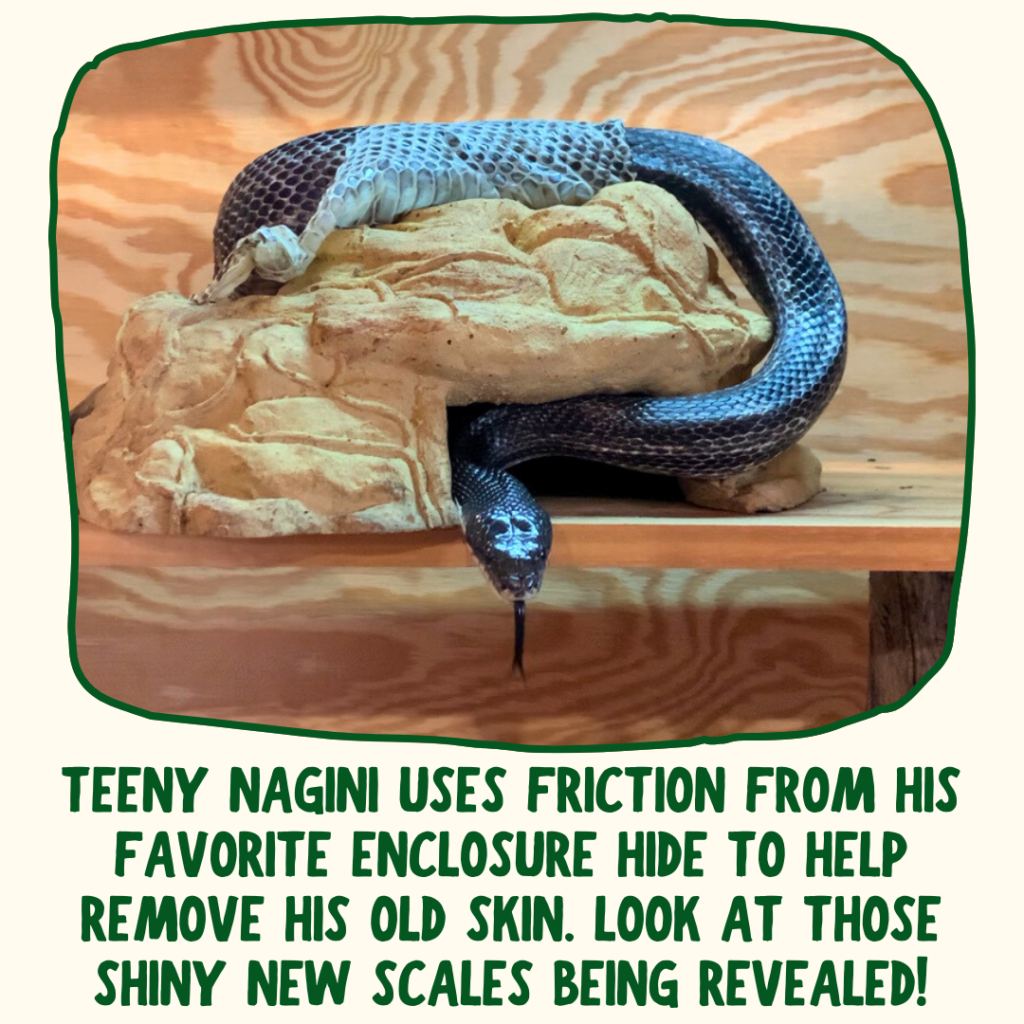
In light of wrapping up the Year of the Snake, we thought we’d use this month’s Critter Corner to shed (heh) some light on the often-seen yet underappreciated Central Ratsnake. 👀
Now, we know some of you out there might run screaming from this email – but we beg you to keep reading! It’s true that snakes typically elicit strong feelings from most people, either of distaste or deep adoration. It’s also sadly true that we lose social media followers and email subscribers every single time we write about snakes. 🙁 We hope today those of you who aren’t snake fans might stick around, knowing that our expectation isn’t for you to suddenly love snakes. Our goal is simply to increase tolerance and encourage more people to leave them be.

The Ratsnake Drama
To kick things off, we have some important quotes to share:
“Tortured and tumultuous”
“Unsettling”
“Overtly chaotic”
“#@%&!”
These quotes have not been pulled from reviews of the new season of Netflix’s hit reality show, Love Is Blind. Believe it or not, they’re real phrases used by scientists to describe the sheer drama of ratsnake taxonomy (the scientific naming process) in a real peer-reviewed paper. It’s about to get juicy, folks!
Our long, black, scaly neighbors get called all sorts of things colloquially. You might hear folks call them black snakes, black ratsnakes, pilot snakes, or chicken snakes. For a long time, though, scientists considered the official common name for Pantherophis alleghaniensis to be the Eastern Ratsnake…but not anymore.
That’s where the taxonomic drama kicks in. As one herpetology blogger wrote back in 2016:
“Nothing is causing more confusion, frustration, squabbles, duels, divorce, Facebook ‘unfriending,’ and countless other disasters than the current state of North American Ratsnake taxonomy.”
For decades, ratsnakes were named and speciated based on morphology (appearance). That meant Virginia’s ratsnakes were called Eastern Ratsnakes based mostly on their coloring and some early genetic data. However, a 2021 genetic analysis of thousands of individuals showed that our ratsnake neighbors here are actually Central Ratsnakes, genetically distinct from the Eastern Ratsnake (Pantherophis quadrivittatus) that lives east of the Virginia fall line down to the Florida Keys. 🤯
This revelation has caused significant upheaval within the herpetology community. However, it seems settled for now, despite the naysayers. The Society for the Study of Amphibians and Reptiles formally adopted these taxa in the long-awaited 9th edition of the Scientific and Standard English Names of Amphibians and Reptiles of North America North of Mexico, released just this past April. Oh, you haven’t read that cover-to-cover yet?! Better get to it! 😆

A Quick Aside
Curious to nerd out even more? Check out the full paper published in Herpetological Review back in 2021. It skims through the ratsnake complex’s taxonomic history and includes a delightfully passive-aggressive warning from the authors about those who “wish to retain taxonomies generated from limited data and assumptions […] made in the 19th and 20th century:”
“Such a prescriptivist notion of scientific progress is at odds with the empirical reality of how research is conducted in the field and is not conducive to intellectual growth.”
We love when scientists get feisty. Universally good advice in these trying times! But we digress. Back to snakes…

Central Ratsnakes in Virginia
Studies cited by the Virginia Herpetological Society found that Central Ratsnakes are the most commonly encountered species in Virginia. Humans often find these non-venomous snakes in their yards or on roads, and they sure make great neighbors: their primary food source is small rodents, including invasive house mice and Norway rats that plague homes around Virginia. If you see a Central Ratsnake hanging around your house often, leave it be – it’s likely taking care of a rodent problem you didn’t even know you had. Thanks, snakes! 🐭
Right now, though, most humans aren’t encountering these critters. Like other reptiles, Central Ratsnakes brumate through the winter. Though typically solitary as adults, these snakes will sometimes hibernate in communal dens. They might even share a big den with other species, like Eastern Copperheads. Sharing is caring! 🤗
Once April rolls around, Central Ratsnakes warm up and start hunting for prey and for mates. Male snakes use a female’s pheromone trail to locate her once she slithers into his territory. Then, he’ll do his best to woo her…or fight off rival males who also showed up in hopes of a hot date. The successful male then initiates a mating “dance” where the two snakes wrap around each other. The mom-to-be continues on her merry way afterwards, laying a clutch of around a dozen eggs a few weeks later. That’s the extent of the not-so-doting mom’s care. Reptiles are on their own, from the second they pop out of that egg!

Surviving In The Wild
Naturally, predation from animals like hawks, foxes, raccoons, and even bigger snakes leads to a high infant mortality rate. Camouflage is especially important for these slithering youngsters as a result.
Juvenile ratsnakes have a distinct gray pattern on their backs, providing a better ability to blend into the leaf litter on the forest floor where they start out. That pattern fades to black once a snake reaches around two feet in length, giving adult Central Ratsnakes their signature glossy, sleek look. They know that black never goes out of style! 💅

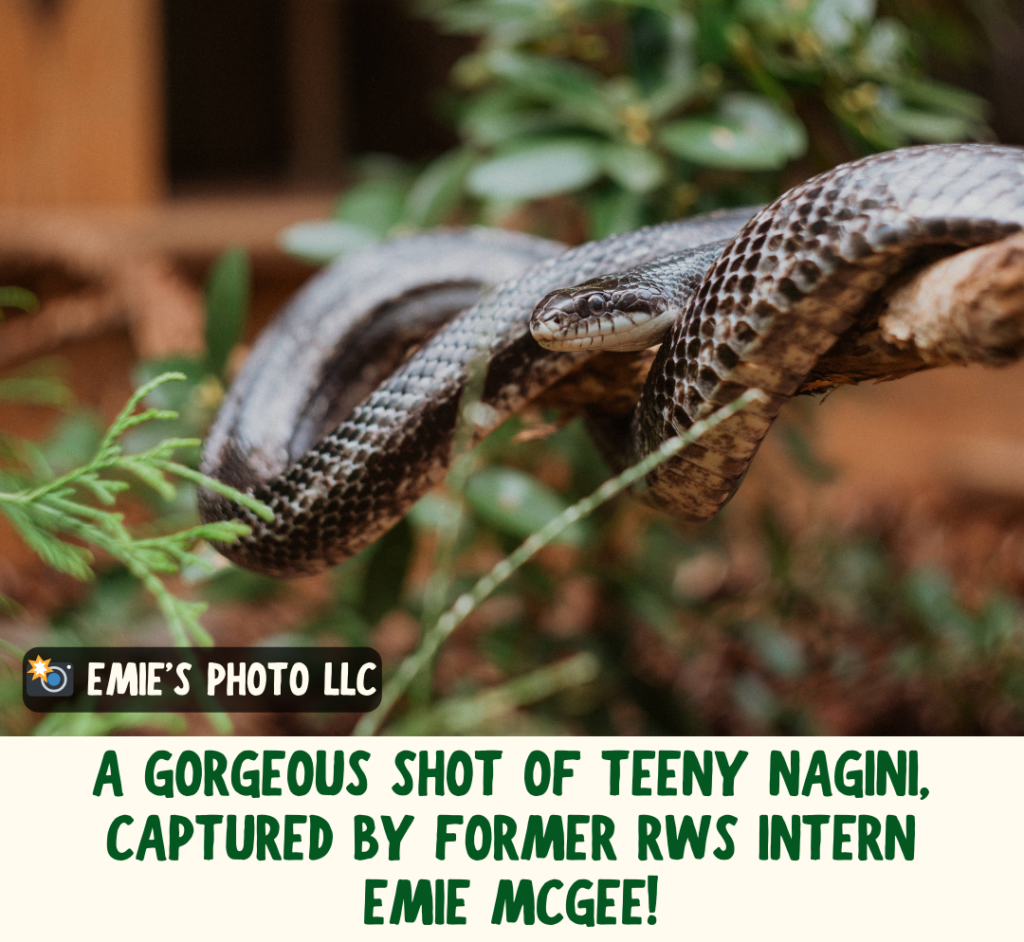
These snakes keep growing, too. They’re Virginia’s longest native snake, with adults ranging anywhere from 3.5 feet long to 8 feet long. Education ambassador Teeny Nagini is about 7 feet long these days, and he continues to grow in our care.
Despite their large size, these snakes have no trouble at all quickly shimmying up trees.

Their ability to easily scale walls and trees alike has led the joke among herpetologists that if you look up and wonder, “How did that snake get up there?!” — it’s probably a ratsnake.
The vertical antics of ratsnakes have also inspired fan groups like the lighthearted “Ratsnakes in Predicaments” Facebook group. ⬇️

If you’re observing a Central Ratsnake above you on a branch (or maybe in your shed), you might notice its strikingly white belly. This is an example of countershading, a kind of camouflage where the back of an animal’s body is dark and the belly is white. Whether a predator is looking at the Central Ratsnake from above or up from below, its dual-sided camouflage keeps them blended in.

The Central Ratsnake: Award-Winning Actor
Central Ratsnakes even alter their behavior to help them camouflage. Have you ever come across a ratsnake, only for it to suddenly “kink” its body? This fascinating behavior allows the snake to morph from a sleek, straight snake into a twisted branch or root.
Sure, it’s not that effective on us humans, since we have great vision. However, considering that many forest-dwelling predators are hunting primarily using their ears or noses, that sudden kinking might just be enough to convince a predator that they’d just stumbled across a stick.

If that excellent camouflage fails, though, Central Ratsnakes put on an Oscar-worthy performance! 🎭 They exhibit Batesian mimicry, where a harmless species imitates the appearance or behavior of harmful, toxic, or unpalatable animals to ward off predators. For example, Central Ratsnakes flatten their heads to appear more like a venomous Copperhead and rattle their tails to sound like a venomous Timber Rattlesnake. A scared ratsnake will also assume a defensive posture where it rears up and lifts its head. This would make it easier for them to strike, if necessary. It’s an impressive display! It also means you need to take a big ol’ step back, buddy. ⚠️
Ratsnakes as Neighbors
As we mentioned, Central Ratsnakes really do make great neighbors – and they are long-term neighbors, too. A ratsnake’s typical home range is just about 0.38 miles in diameter, and they spend years in the same territory — if not their whole lives. That means that ratsnake in your yard is probably the same one you saw last year, and the year before that. With lifespans of about 15 years in the wild, there’s a good chance your ratsnake neighbor even lived there before you did.

Now, we think it’s best to be polite to your neighbors. You probably already know the basics when it comes to being kind to your human neighbors, but there are plenty of easy ways you can support your snake neighbors too.
- 🐭 Ditch the glue traps and rodenticides. Seriously! These “pest control” methods are indiscriminate and impact many species beyond whichever ones you’re trying to get rid of. They also lead to truly cruel deaths. If you don’t want snakes around, remove habitats like brush piles and seal up spots where snake attractants, like mice, might be getting in.
- 🧑🌾 If you garden, consider switching to wildlife-safe netting! Opt for rigid fencing like chicken wire or netting that is stretched taut and secured. Taut fencing keeps plant-munching deer out while still allowing snakes to pass through without risking entanglement. Then, they can eat the mice that are eating your veggies. It’s a win for everyone.
- ❌ Do not trap and relocate snakes. It’s illegal to trap and relocate a wild animal from your property. Plus, moving a snake to an unfamiliar territory can lead to its death and spread dangerous pathogens like Snake Fungal Disease.
- 🚙 Drive carefully! It’s common to see Central Ratsnakes crossing roads or absorbing heat from the pavement shortly after sunset. You can be an even better neighbor by using a stick to shuffle a snake to the side of the road it’s heading towards.
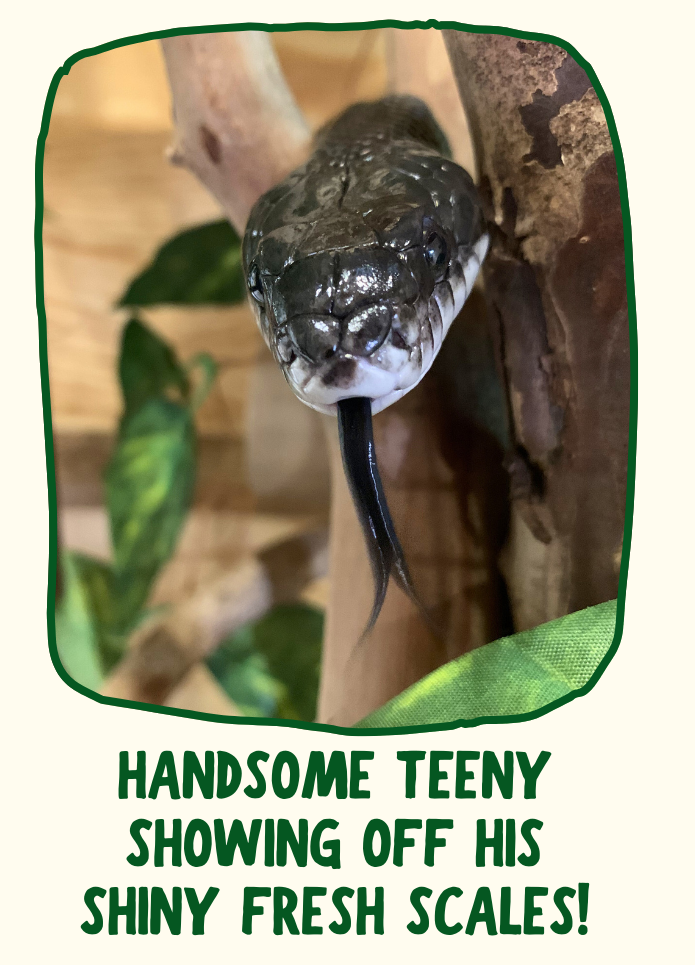
Though the Year of the Snake is technically behind us, we’re always celebrating snakes here at RWS. Who else can shed their entire skin at once, like taking off a t-shirt, INCLUDING their protective eye cap scales? ⬇️

Okay, perhaps that’s not the most alluring fact to end on for those of you who still aren’t convinced about the charm of the Central Ratsnake…but hey, you made it this far. Thank you. ❤️
Cheers to all of those out there who open their minds up to all of the world’s wacky, helpful wild creatures! 🐍
Thanks for reading this month’s Critter Corner. When you hear from us next, you might just be reading about the first baby animal patients of the season. 😉
February 26, 2026
Published:


Be the first to comment!