


Meet July’s Patient of the Month: Ruby-throated Hummingbird 26-571! 👋
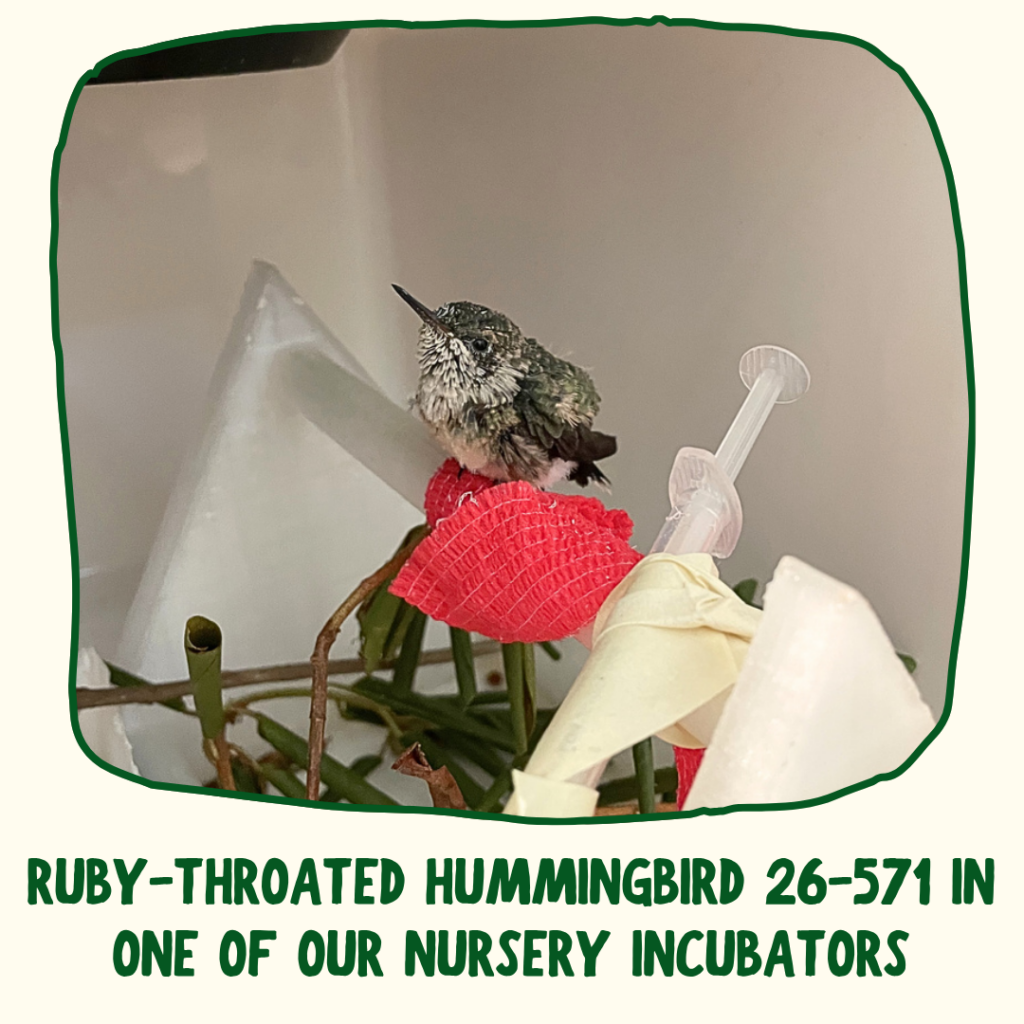
This teeny bird arrived after being rescued in Buckingham County early last week. A community member found the hummingbird baby in her driveway, sitting on the ground beneath a tree that had fallen in a particularly powerful summer storm. Unfortunately, the rescuer could not locate the nest – which doesn’t surprise us, given how small and camouflaged hummingbird nests are.
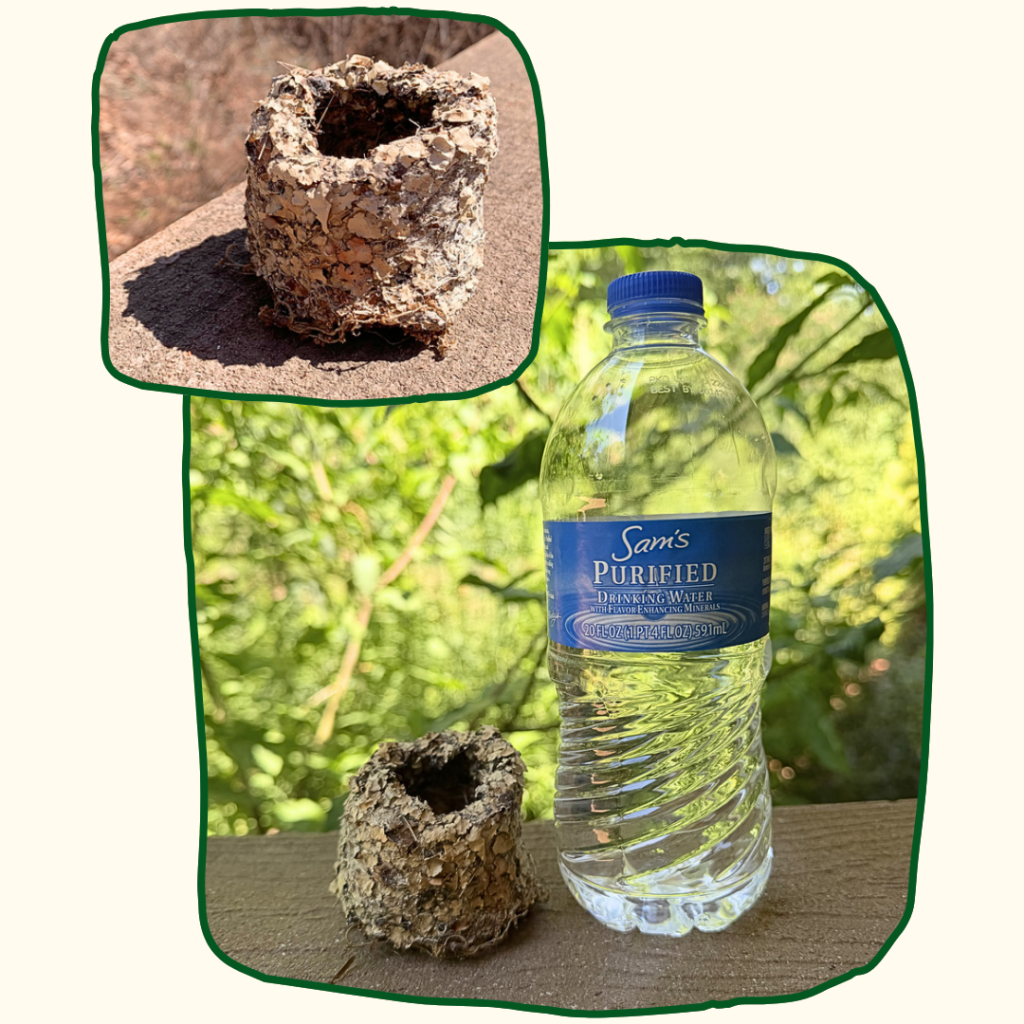
We found an empty hummingbird nest in our own driveway years ago. Though the bright green lichen has dried to brown, you can see how tiny they are when compared to this water bottle! ⬇️
We were grateful to this baby hummingbird’s rescuer for calling our hotline. ☎️ After realizing re-nesting would not be possible, the rescuer kindly made the trek to RWS so we could admit this patient for care.
And just like that, this little hummingbird nestling became RWS patient 26-571!
On intake, our team found the baby hummingbird to be in relatively good health despite some mild dehydration. We got to work setting them up for a successful recovery. (There is no way to determine the sex of a fledgling Ruby-throated Hummingbird. The male birds don’t develop their trademark ruby red plumage until after their first winter. We’ll simply use “they” for now!)
Effectively rehabilitating hummingbirds is complex and notoriously difficult compared to caring for other avian species. Part of that challenge is that hummingbirds are extremely fragile. Patient 26-571 weighed just about 2 grams upon admission. That’s roughly the weight of a penny! ⚖️
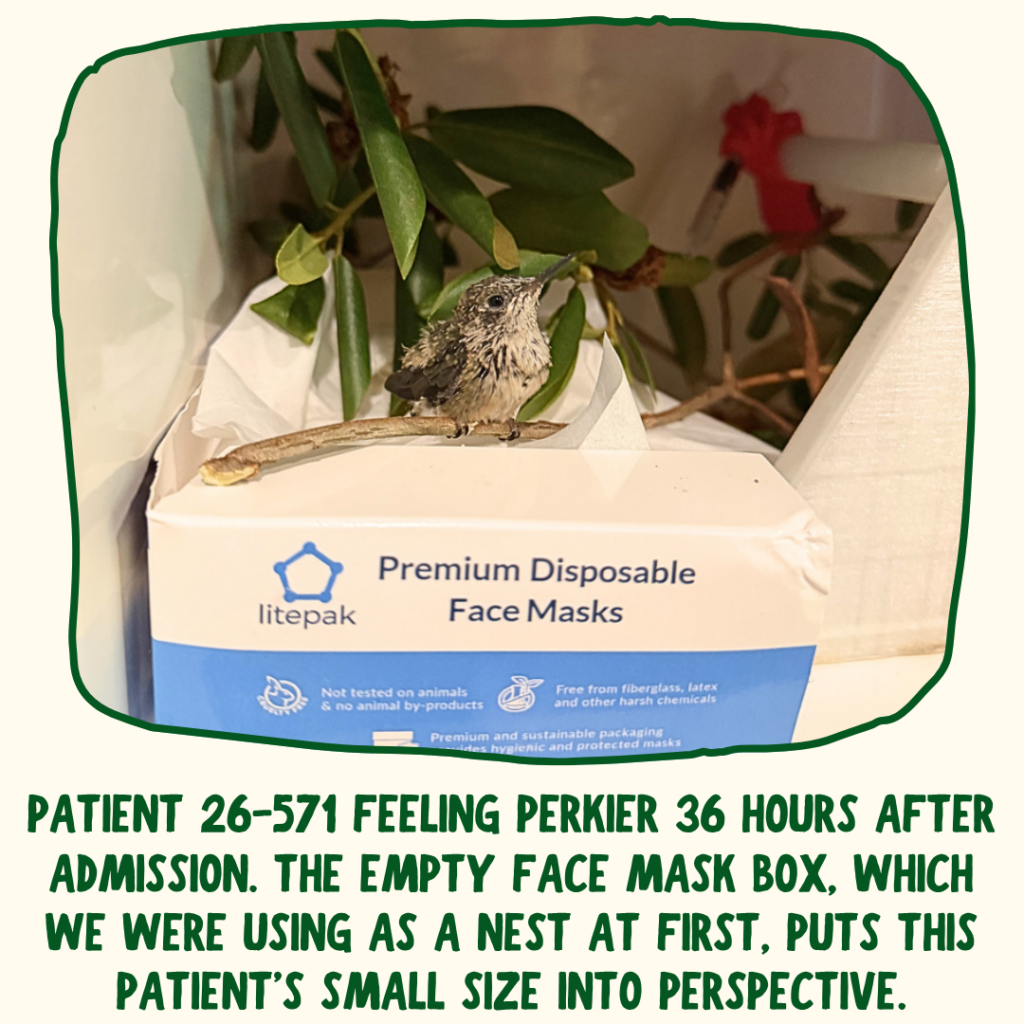
Because hummingbirds are so delicate, every aspect of their housing in rehabilitative care has to be just right. 🏡 For starters, we have maintained a strict “no handling” rule to prevent any mishaps, as even the gentlest hands can be too powerful for a fledgling hummingbird. We also had to find the perfect perch for this baby right away. These birds cannot walk or hop – they can only perch as they grow the feathers needed for flight. A perch that’s too big or too small can cause irreparable damage to a baby hummingbird’s skeleton within just a day or two. The perfect perch for patient 26-571 was a small, leafy twig from our pollinator garden!
The hummingbird spent its first few days in care inside our smallest incubator. This space allowed us to maintain a warm temperature and higher humidity level while the bird adjusted to rehabilitative care and recovered from dehydration. They have since graduated to a soft-sided enclosure in our nursery, though! Inside are plenty of perch options, natural leafy cover picked from the garden, and of course, some flowers. 🌸
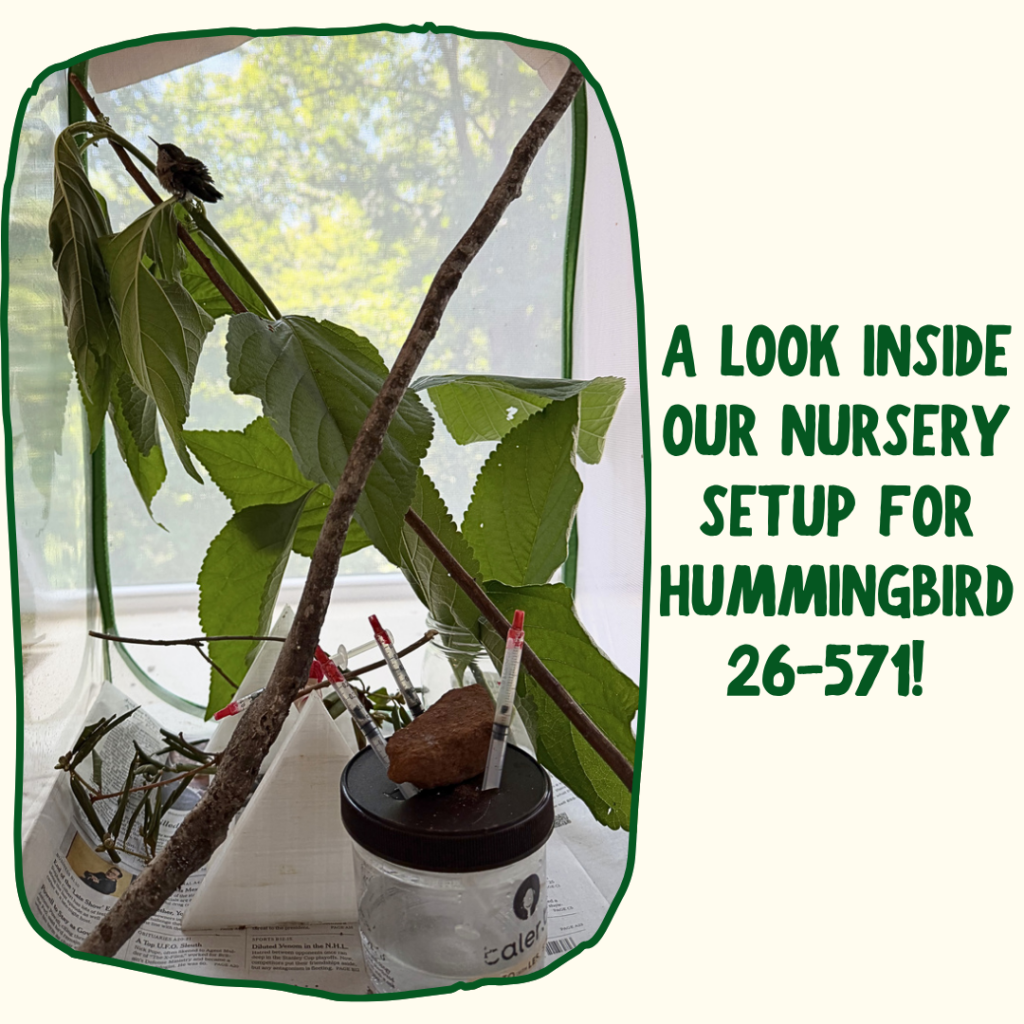
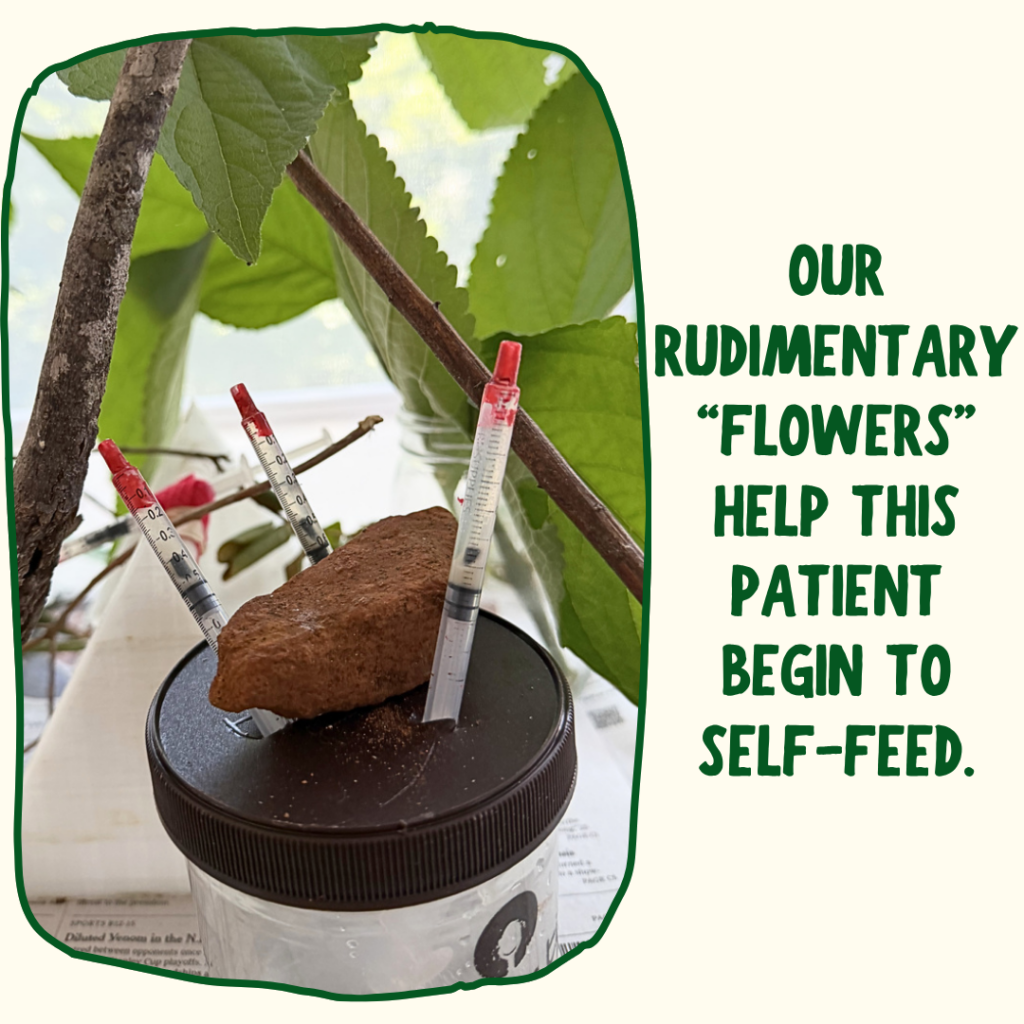
Well, not real flowers just yet. Some plastic “flowers” are doing the trick! 💐 They’re simply 1 cc syringes, filled with hummingbird formula, and painted red at the tip. Hummingbirds are most attracted to red and orange tubular flowers, so this is an important first step in teaching a young hummingbird how to recognize and feed from a real flower. Patient 26-571 is starting to get the hang of it!
Speaking of flowers: correct nutrition is absolutely critical in hummingbird rehabilitation. With lightning-fast wings that flap 80 times per second and a heart that can beat 1,300 times per minute while in flight, these tiny birds need a near-constant stream of high-energy foods to survive. ⚡️
Hummingbirds are famous for feasting on flower nectar, but that’s far from their entire diet. You might be surprised to learn that they eat a ton of insects as well! Bugs like gnats, aphids, mosquitoes, and spiders provide hummingbirds with the much-needed protein and fats to maintain energy reserves and sustain long days in flight. 🦟
A quick fun fact, since we can’t help it: spiders aren’t important to hummingbirds just as a food source. Hummingbirds rely on spider silk to construct their nests! The fine, sticky silk acts as a glue to hold the lichen and moss together in their nest’s cup shape. Now you might not like spiders, but you probably like hummingbirds. They can’t exist without spiders! 🕷️
This is all to say that sugar water is not enough to sustain a hummingbird – especially not a young fledgling. To feed 26-571, our team prepared a special nectar formula that has a higher protein percentage than what folks typically use at their feeder. With a 1 cc syringe and a tiny stainless steel cannula tip, we carefully put a few drops of the formula into their crop. Luckily, the hummingbird has been a very eager eater. They gape for us when we stop by to feed them – every 15 minutes, all day long!
Here’s a quick look at hand-feeding this patient. Turn your sound up to hear their adorable chirps! ⬇️
Though our prognosis remains guarded due to the sensitive nature of this species, one thing is for sure: we have all been totally charmed by this adorable baby hummingbird. We hope to continue watching them stretch those wings, drink from fresh flowers picked from our pollinator garden, and be successfully released in about 7–10 days after a brief acclimation period outdoors. Keep it up, little hummingbird! 👏
Thank you for reading about July’s featured patient!
If you’d like to support this hummingbird’s care (and the hundreds of other patients currently on site!), please consider becoming a monthly donor. Giving just $5 per month truly makes a difference for our community’s animals in need. 💚
And don’t forget to save the date for our Mountain View Magic fundraiser on October 2! 🪄 We’re so excited to share an enchanting evening with you in celebration of native wildlife.
July 15, 2026
Published:


Be the first to comment!